Blog

  • We’re Stuck in Monkey Loops

    We’re Stuck in Monkey Loops

    It’s definitely not the case that we’re very good at understanding what our brain and body actually want. There are too many signals coming at us from all directions, both inside and outside ourselves. Learning to consistently Fourier transform that constant stream of input is already difficult, and teasing out actual cause and effect is even harder. To make things more complicated, what you’re drawn toward is not always what you actually need, because certain things can override the subtler signals of your body by hijacking your brain chemistry.

    In the modern world, this discrepancy is especially obvious because companies know that if they can manipulate your brain chemicals, they can convince you to buy things or engage in behaviours that maybe aren’t good for you, but make them a lot of money. We’ve reached a stage of history where an enormous amount of research has been done, information is widely available, and much of this practice has been refined into a pure science. This is definitely not great for the wellbeing of the average person. Daily life starts to feel suffocating because we’re constantly battling junk that’s competing for our attention: advertisements, social media notifications, ultra-processed food wrapped in bright colours and tempting commercials, clickbait headlines, endless feeds. At a certain point, it’s all just plainly exhausting.  

    Whenever I feel lost, I like to look back at the way humans evolved. People often talk about how evolution moves extremely slowly, while culture and society, especially in the digital age, evolve absurdly quickly. One example I hear people talk about is our relationship with sugar. Early humans almost never encountered anything close to pure sugar; maybe fruit, maybe some honey if they were willing to fight a beehive for it. But now, sugary foods are everywhere, often cheaper than healthier alternatives, and engineered to taste incredible. What exactly are we supposed to do with that?

    Another example people bring up a lot is anxiety. Our brains evolved to experience some baseline level of anxiety because, historically, there really was bananas stuff happening all the time. But now, when most people are most often relatively physically safe, the brain still insists on manufacturing threats and stress responses for situations where constant cortisol is mostly useless.

    I was watching a YouTube video by a doctor talking about learning how to rest and recover properly. You can watch it here – it’s reasonably short and sweet and contains a lot more interesting stuff than what I talk about here. He mentioned something that really caught my attention: when the brain becomes tired, you start experiencing decision fatigue. That’s apparently one of the clearest indicators of mental exhaustion: just look at how difficult it suddenly becomes to make simple choices.

    When the brain is low on energy, its instinct is to choose whatever requires the least effort, because from an evolutionary perspective, low effort meant conserving resources. Back then, though, low effort also usually meant low stimulation: in other words, rest. In our modern world, that’s not really the way it works anymore.

    Because of the immediate micro-rewards we get from scrolling and, let’s say, other “chemically juicy” activities, it’s often easier to reach for internet-based stimulation than to sit quietly or do something slower and less rewarding. I’m pretty sure the brain runs some kind of short-term cost-benefit analysis, and the short-term dopamine hit wins almost every time. The problem is that when your brain is already low-energy, it’s also decision-fatigued, meaning you’re even more likely to choose the easiest option available. Modern life has created a horrible feedback loop where the “easiest” option, the choice you’re most likely to make, also further exhausts your brain by bombarding it with lights, colours, novelty, emotional prompts, and constant stimulation. So your brain gets more tired, which pushes you further toward the short-term dopamine rewards, which tires your brain even more.

    The doc in the video also said that physical exhaustion clears noticeably with sleep, but sleep doesn’t do a number on mental exhaustion in the same way. Scary stuff.

    He offered a few practical bandaids for dealing with this. One is to make the “hard” option require as little decision-making as possible. Remove planning and coordination wherever you can. For example, schedule fixed gym times every week so you don’t have to negotiate with yourself about whether or not to go. The habit itself also creates momentum, which helps reduce friction. Another suggestion was to avoid overcomplicating the planning of difficult tasks. Don’t spend thirty minutes engineering the perfect workout. Just get yourself to the gym and figure the rest out once you’re there. The third was reframing effortful activities as active choices rather than obligations. You’re choosing to go to the gym because you care about your health and want to be responsible for yourself, not because some external force is punishing you into doing it. “Shoulds” and “oughts” can take a lot of the joy out of life.

    All of these things help you choose the harder, less immediately satisfying option. But they aren’t cure-alls, and they’re not automatically spiritually nourishing either. Honestly, the only thing that has consistently helped me make structural changes around addictive behaviours is understanding what’s actually happening in the brain when I’m already overstimulated (or otherwise feeling yucky) and still choose to further overstimulate myself (or do something that’s going to feel good temporarily but make me feel more yucky in the long term). Understanding the loop itself matters. The dependency. The way the brain twists into patterns that reinforce their own continuation.

    It’s not perfect. I scrolled Facebook Marketplace way too many times today and fried my prefrontal cortex. None of the YouTube videos I tried to watch during dinner were even remotely satisfying, despite my many attempts to stick with one. But somehow, here I am, writing this instead. Thankfully, I had enough wherewithal today to remember that video, and realize that maybe my brain wasn’t actually incapable of doing the harder thing. Maybe starting just felt monumental because I was already scattered from all my phone gooning, and what I really needed was a single activity to affix my attention to.

    So I guess surviving modern life has a lot to do with understanding the loops in the brain that fold in on themselves and quietly push you toward behaviours that aren’t actually good for you. This is a responsibility that has been thrust on us, I would say unfairly, and if you’re suffering, just know that it’s because none of us were built for this shit. 

  • On (and Under) One’s Boulder

    On (and Under) One’s Boulder

    I used to have this grand idea that the reason for experiencing life was so that the cosmos (harbouring some kind of “universal consciousness”) could come to learn about itself. I think that belief came from the idea that we’re all fundamentally connected to some “source,” and that we’re really just observers witnessing our lives unfold; our observer-self doesn’t even have any meaningful tie to the life it’s watching, aside from the cosmic pairing that somehow connected it to a body. The thought was that maybe the universe developed consciousness across different beings and forms as a strange mechanism for understanding itself, in the same way that we developed consciousness, and, as a consequence, became capable of understanding ourselves in ways unconscious creatures cannot.

    Because of this, I thought it deeply important that people increase their awareness and self-awareness, because consciousness, specifically this interconnected, metaphysical kind, was the highest purpose one could serve. You were doing your part by allowing the universe to unfold and understand itself, and all that was ever expected of you was to fill out your particular corner of the universal map of all possible things, which would then fold back into the collective pool of conscious experience. That underlying belief played a nice role in my life for a good long time.

    Lately, though, maybe because of the hedonic treadmill and the brain’s inability to ever be satisfied, I don’t find this reason to push forward into the world nearly as convincing anymore. For one, in this worldview, you must entertain the idea of the universe as a kind of deity. This is fun, but has its limits. And two, being human, I had created my god in my own image: something that places self-understanding above all else.

    How exactly did I convince myself I knew what the universal consciousness wanted? Probably youthful audacity mixed with the need to funnel my religious inclinations into something other than science for a change. And honestly, I still respect my younger self for that, because I firmly believe you have to create whatever reality stirs your coffee every morning. But somewhere along the line, to my own disappointment, I think I stopped caring what the universe “wanted” from me. Or maybe I stopped believing that just because I personally value self-knowledge above most else, I can safely project that value onto reality itself. As below, so above.

    Inside myself, I feel a belief forming that a good life requires both the pursuit and achievement of forward progress (or at least the illusion and hope that you are moving toward some better future, however nebulous) balanced with enough presence and mindfulness to appreciate how far you’ve already come and the many marvels of the world around you. My brain doesn’t seem capable of being happy with only one or the other. I need progress. I need hope. I need narrative. But I also can’t appreciate anything I’ve done, all the skills I’ve developed, or the extent of the person I’ve become unless I deliberately slow down and contemplate enough to really feel it. Without this, you become an endless climber who never even stops to appreciate the view.

    At least with the brain I was gifted, if I’m not moving forward, upward, onward, it becomes difficult to even grasp the wonderful things happening around me that have nothing to do with achievement at all. When I’m delighted by momentum and confident in myself, it becomes much easier to appreciate the beauty of a rose, which, in turn, deepens my conviction that the universe is fundamentally a kind and beautiful place. But apparently, I have not gone through enough therapy to just smell the roses before my positive self-image is “justified”—or, perhaps, without fundamentally believing the future is going to have even prettier and smellier roses. Without “forward”, it’s easy to slide into what the young people might call a “depressive episode”.

    I suppose that’s a pretty good sign that my confidence, even after all this time, still depends at least somewhat on the world around me. But I think I’m banking on this idea that if I balance forward movement and quiet contemplation for long enough, I can create a kind of self-sustaining joy and belief in my own worth, even during periods when I’m not making meaningful progress in the areas of life I care about most. Even though I’m not holding on as tightly as I used to, and even though I now carry a certain je ne sais quoi because of everything I’ve stomached, metabolized, and grown from, maintaining forward momentum in my life is still one of the best ways I know to ensure I’m continually capable of appreciating the elegance of existence all around me.

    So, in the meantime, before I either achieve ultimate enlightenment and detachment or fall victim to my own fallacy, I have a survival strategy. I took inspiration for this from aging and/or deceased relatives on the Ukrainian side of my family. Many, if not all of them, developed a kind of dour intensity in old age. I once asked my father why all his relatives seemed so grumpy, and he said, “It’s a life force. It sustains them.” And… yeah. I think there’s something to that.

    We are born into this universe already engaged in a fight against entropy. Some people are lucky enough to inherit lives with structure and order built in from the beginning. They learn early how to create and maintain systems that keep them suspended above the roughness of the road beneath them. For others, the baseline is much more chaotic and far less stable. But wherever you land on that spectrum, one thing remains true: you must work every single day to maintain yourself and your life. Eat, clean, exercise, plan, exert, manage, converse, haggle, spend, save, play. You cannot really take your foot off the gas, because the moment you neglect something, it has a nasty habit of dragging you further into whatever black holes the universe is already trying to slide you toward.

    So what can actually, reliably keep Sisyphus from getting flattened by the boulder?

    Spite, maybe. The sheer refusal to accept that the universe placed you on this path with your boulder, and that the unfair punishment for stopping is suffering by crippling stagnation: the slow erosion of your strength, your momentum, your capacity, and your ability to smell the roses. Since losing the belief that I’m somehow meant to be gathering experiential data for the universe, I can at least grit my teeth and draw strength from the knowledge that, yes, I was designed as an organism destined to eventually succumb to the entropy surrounding me, but fuck you if you think I’m going to let everything collapse without a fight.

    If I can’t find permanent peace in the act of pushing the boulder uphill, then I will at least become exceptionally good at pushing it. I’m going to get stronger, and eventually the push itself is going to look effortless. I think this is the closest I’ve ever felt to touching lasting satisfaction with the human condition.

  • The Body Knows Your Fashion Crimes

    The Body Knows Your Fashion Crimes

    I find the ways that human beings respond to aesthetics to be deeply interesting. We, as a species, seem to possess a nearly animal sensitivity to congruence; that is to say, we are constantly, instinctively scanning for harmonies and disharmonies between things. We can notice when a song and a photograph somehow contain the exact same emotional texture. We notice when a painting reminds us of a particular person. We notice when somebody’s bedroom or dog looks exactly like them. We notice, at least subconsciously, when somebody’s outfit appears to be wearing them, rather than the other way around.

    There are certain people who feel so coherent that every object surrounding them starts to look like an extension of their internal world. Their jewelry makes sense with their voice. Their apartment makes sense with their posture. Their makeup makes sense with the cadence of their speech. It all appears to emerge from the same source, the same underlying current. Even if you dislike the aesthetic itself, the harmony is palpable. Something in you relaxes around it.

    What we often call a “vibe” is simply this underlying coherence made perceptible. A vibe is not tied to a particular medium. The same emotional essence can exist in a painting, a song, a building, a person, or a coat. Sassy and zany is a vibe. So is softness, sleaze, intellectualism, tenderness, sincerity, and industrial coldness. These things can all be translated between mediums like a kind of emotional language.

    Artists do this constantly. A good artist can take a feeling and package it into their medium. Another artist, working in a completely different medium, can package the same feeling in a completely different form. The observer recognizes the commonality instinctively.

    Humans are strange ecosystems made up of thousands of feelings, patterns, instincts, aesthetics, and selves layered on top of one another. The world responds to you according to the version of yourself that you present, but more strangely, you also begin responding to yourself that way. If you dress polished and elegant, people unconsciously expect elegance from you. If you dress chaotic and playful, people unconsciously make space for chaos and playfulness. If you present yourself like somebody worthy of being listened to, people often listen. Because humans (including you!) are socially porous creatures, you start actually becoming more of whatever is being reflected back at you.

    This is part of why confidence is so reality-altering. Human beings reorganize themselves around certainty. The universe itself almost seems allergic to incongruence; if one person refuses to budge in their belief about who they are, eventually the social world around them starts bending to accommodate the claim. I do not fully understand it. I only know I have seen it happen too many times to ignore.

    Clothing is especially interesting because it sits directly on the body. It is probably the fastest and most accessible way to alter your relationship to yourself.

    To lead with my own example: for a long time, I dressed almost exclusively in ways that emphasized the intellectual parts of me. Respectably intellectual. Slightly frumpy. Thrifted. Eco-conscious. Clothes that suggested I cared more about ideas than appearances. Lots of sweaters. Ill-fitting pants and unflattering t-shirts. Things with holes (some of you know the horror of my old Converse hi-tops…) that at some point certainly crossed the line from charming to concerning.

    And to be clear, that version of me is real. I am intellectual. I do love old things and books and little objects with history attached to them and wearing shoes until they fall off. But over time, I began realizing that I was not merely expressing that side of myself. I was reinforcing it. Every day, I was participating in a feedback loop that amplified a particular mode of being.

    The problem was that this version of me was not always especially happy. She tended anxious. Self-conscious. Awkward and afraid of being perceived. Often uncomfortable with taking up space. Frankly, some part of her, somewhere, thought herself low on life’s social totem pole. There was a kind of flattening effect happening where my presentation was emphasizing some of the least joyful parts of my personality while suppressing others that were equally real.

    I know now that I am not only that person. I also love softness. Glamour. Nice tailoring. Leather. Leopard print. The occasional hyperfeminine silhouette. Luxurious fabrics. Sleaze. Rhinestones and sparkles. Taken all together: the aesthetic sensibilities of a woman who has a well-paying job but put herself through graduate school on the dime of shady nightclub patrons.

    What shocked me was not merely that I enjoyed dressing this way, but that doing so, even in small ways (but nonetheless really mentally and emotionally leaning into it), altered my internal landscape almost immediately.

    When I dress in ways that feel glamorous and coherent and embodied and sensual, I become more audacious. Quicker. Wittier. Less fragmented. Less afraid. I make more eye contact. I flirt more with life, and encourage life to flirt back. I speak more directly. I stop shrinking. I become more playful. More magnetic. More alive. Importantly, this does not feel false, which is the part that interests me most.

    People often talk about fashion as though it is either superficial performance or authentic self-expression, but this binary is incomplete. Humans are multifaceted. Most of us contain many legitimate selves, many dormant emotional configurations, many possible ways of moving through the world. Clothing does not necessarily fabricate an identity from thin air. Often, it simply calls one forward.

    This is also why some outfits feel can “wrong” even when they are objectively attractive. Sometimes the proportions or colours are genuinely bad, yes. But often, the discomfort comes from the fact that the clothing is asking the wearer to embody an energy that they either do not possess or do not trust themselves enough to access. The body knows when crimes of incongruence are being committed. The most beautiful dress in the world cannot save an outfit that is fundamentally disconnected from the person inside it. Conversely, I have seen people wear objectively bizarre things with complete conviction and somehow transmute them into coherence through sheer embodied certainty.

    I think this is why style can become something almost spiritual; selfhood is strangely malleable, and aesthetics are one of the ways we communicate with the subconscious mind. If there are parts of you, even unrealized, that are sensual, capable, elegant, playful, dangerous, soft, intelligent, glamorous, or bold, and you repeatedly present yourself as such, eventually a part of you, the doubtful part, begins believing it. And, as we previously established, once you believe it, other people often do too.

    So, I think the goal of fashion and style is to become intimate with your own multiplicity, and to notice which modes of selfhood that your chosen aesthetics nourish. In other words, realize that you are not just choosing between authenticity and inauthenticity, but between different authentic modes of self-expression that can help you, each day, become the person that you want to be.

  • March Thirty-First

    March Thirty-First

    A verse calls forth
    The story of a fall
    The trenches endless,
    The tunnels twining, a-lined
    With grazing hands
    And oily fingerprints

    You may grin tightly,
    You might notice a slight sting
    Of two desperate eyes’ contact
    Daring not look down,
    Black marks often threaten residence
    Perchance, it’s okay if
    You hold. You hold, and you hold

    And you scrape,
    And crawl,
    And coast where you can
    Believing it your destiny
    On your forearms and shins
    Broaching raw and ragged

    One need only see
    Relief once, these sweet words themselves
    Would rejoice and learn to hear
    For what is it to bask in?
    It knows naught but one great ocean
    And to thee, I have but one question;

    A heart shared divides worlds into one
    Glittering magnitudes can shine light
    Into cobwebbed corners
    Forgotten nooks harbour forgotten lifeforms

    The great urge
    To recreate all but
    The greatest love poems, maybe cheaply
    And to believe oneself worthy

    In all its grandiosity,

    Could it really be ours?

  • Some mornings, a coffee barista reminds you of a lost love

    Some mornings, a coffee barista reminds you of a lost love

    I was, if I recall
    Then, mechanistically unromantic
    A clockwork creature
    Desperately hungry

    The world was so new,

    And though I had never been
    The city was bigger than I remembered,
    The gravity of 23+9,
    Much as I explored it
    Explored me

    I haven’t been to Pakistan
    But I recall its subtle poetry in you
    High points on cheeks
    Of drunken escapades,
    Knowing glances
    Exchanged over office sandwiches
    The world’s most interesting playground
    Can appear
    In the most curious of places

    Toronto is not yours
    Nor is it mine,
    We were indeed
    Two extraterrestrials
    Serendipitous on a foreign planet
    Learning metropolitan camouflage
    Sharing winks
    At its various absurdities…

    Playing aloof,
    I replied
    “Even permanent marker washes off”
    When you said 
    I had left a mark on you,

    But how difficult it is to predict
    How a sapling
    Will grow and age
    In your grey matter,
    A new passenger
    Hitched along for the ride

    Someone old 
    You can pick out
    In unsuspecting faces.

  • A Heap Sort,

    A Heap Sort,

    A still life that refuses to stay still.

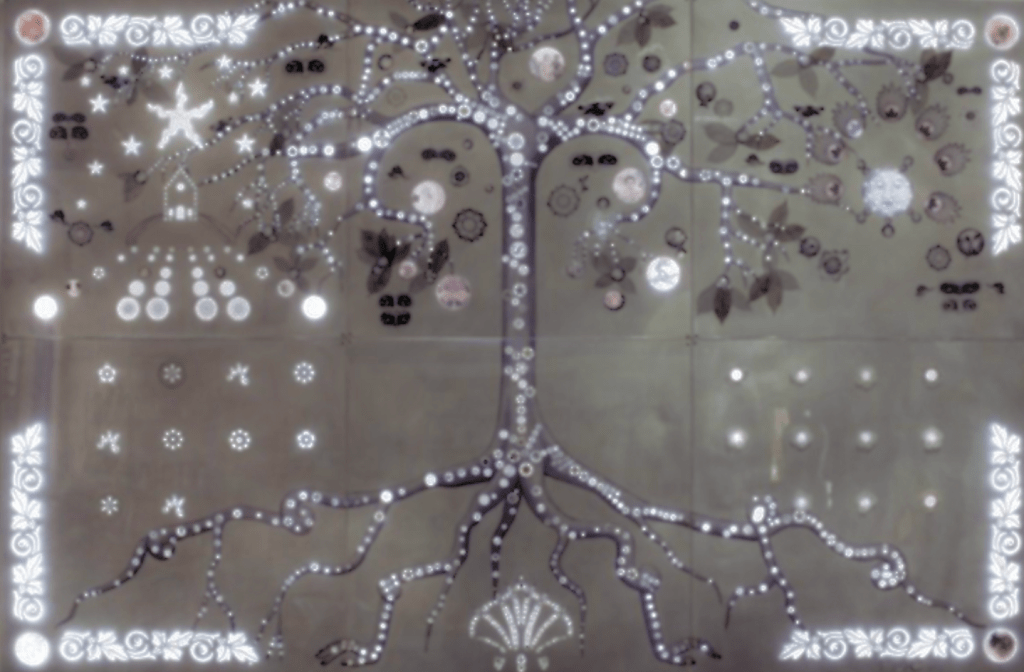
    Sugar and brine touch tongues that shouldn’t meet. Ink stains the water while something bright flashes once and is gone. What’s gathered from the ground is braided, then fed back to fire, which remembers everything. Cloth keeps the gesture of a hand; concrete keeps the gesture of winter. A heart opens and leaks without apology.

    A wing holds light the way a screen holds itself—looped, recursive, and with slight delay. Letters appear in a font that pretends neutrality while smuggling intent; a ± that never decides whether it’s healing or harm. The image watches the image watching the image.

    Caffeine hums like a low prayer to velocity. Fish gleam like punctuation. Dust settles on paper, insisting on time.

    It’s an altar, maybe. Or a debug log. Or a spell assembled from whatever was closest when attention struck.

  • On Soul Weights

    On Soul Weights

    In the platonic space of essences, there is room for everything. To think about all that could ever be, I find it useful—if obviously imperfect—to imagine a very high-dimensional vector space of vibes, ideas, and concepts. One element of this space could be “apple,” another “green,” another “rotten.” Much of what follows is intentionally simplified and not meant as strict mathematics.

    Imagine a human being as something of a multilayered neural network. (A groundbreaking analogy, I know.) Let’s take a vector from this platonic space—say, one encoding “taking a bite out of a rotten green apple.” To see how a particular human would react to actually experiencing (or even just imagining) this, we can perform a forward pass through their network; that is, feed that input vector through successive layers, allowing the information to flow and change as it progresses. At each layer, the inputs are multiplied by that person’s unique weights and passed through activation functions, until we eventually arrive at an output: a reaction vector encoding their emotional, physical, and behavioural response.

    Viewed this way, a human being at a singular point in time is defined by the full collection of these weights—their unique configuration of persuasions, their entire weight matrix. Thus, given different matrices for different people, input A may lead to response B for person C because of weights D, E, and F, but leads to response G for person H because their D, E, and F have different values.

    So let’s try to understand why a human ever reacts the way they do, and where these weights come from.

    Many of the weights fall into what I’ll call the nurture category. These are the tunable parameters in our brains—pliable clay we’re born with so that we can continue to adapt to our environment. For these nurture weights, repetition, habit forming, and feedback loops can increase or decrease preferences and aversions. With patience and consistency, it’s relatively easy to nudge these weights up or down to change outcomes.

    Then there are weights—or clusters of weights—that tend to be relatively fixed, at least from a certain age onwards. I’ll call these nature weights. Some of them are easy to explain through straightforward cause and effect. Hunger reliably makes food evoke a positive response. Fear, being so useful for survival, reliably makes predators evoke a negative one. These weights live in the body, you were born with them, and trying to change them usually doesn’t make much sense because they’re trying to keep you alive. Nature weights also encode one’s physical attributes—like height—which influence how we navigate the world. Plenty of creatures make nearly all their decisions based on these deeply ingrained mappings from inputs to outputs.

    But humans seem to have an additional set of unchangeable “nature” pulls layered on top of these biological, instinctual ones—pulls that don’t reduce cleanly to survival or comfort. This extra component encoded in our weights is what people often refer to as the soul: an idiosyncratic, unchosen essence that meaningfully shapes how a person responds to the world.

    What I want to propose is that this “soul” smattering constitutes a portion of the unchangeable nature weights within our overall weight structure, existing alongside—and interacting with—unchangeable bodily weights and changeable nurture weights. The totality of these weights, applied over time to a stream of inputs from reality (with each output influencing future inputs), produces the trajectory of a person across a lifetime.


    I’ve read books about past lives and the space between lives, often accessed through hypnosis. I’m not especially interested in litigating whether those accounts contain literal truth. What sticks with me is the recurring structure: a soul is paired with a body, the soul forgets itself, and then spends a lifetime trying to remember. Whether metaphorical or not, that understanding has persisted for a reason.

    It often feels as though the soul is constantly calling out to itself in the world. It wants to recognize itself and to be surrounded by the things that make those particular connections in the network sing. That’s why affinities can feel disproportionate to their apparent utility. Yes, strawberries and apples both matter to me for calories. I don’t even think I prefer the taste of one over the other. But strawberries feel like me in a way apples do not. Only one triggers the internal “!” of recognition rather than the indifferent “.” My soul—those unchanging emergent weights that don’t seem grounded in rational necessity—has contributed something extra to the concept of “strawberry,” amplifying my response far beyond bodily need. I don’t even need to think about eating a strawberry; I’m simply glad they exist.

    It’s worth saying that the boundary between nature and nurture is rarely clean. I’m not suggesting that my affinity for strawberries emerged fully formed, untouched by upbringing or chance. Of course it was shaped by countless small experiences—availability, repetition, context, memory. But what feels undeniable to me now is that, through the process of living and paying attention, something stable has emerged: a persistent self-identification with strawberries as a concept that (1) I don’t think I could do anything about if I tried, and (2) itself seems terribly happy that I know about it.

    The “goal” of the soul, if I’m allowed to speak teleologically for a moment, seems to be at least partially self-recognition. Those seemingly frivolous extra units of importance feel desperate to be noticed in a way other kinds of weights are not. There is something about the very existence of these parts of your weight structure that sparkles. Hot pink produces a “!” for me in a way canary yellow does not. Surrounding myself with hot pink doesn’t just feel decorative; it feels aligning. And noticing that “!”—recognizing that here, my soul sees itself—feels almost like the whole point.

    This is partly why exploratory mirroring matters. Sitting in the presence of different people, ideas, aesthetics, and sensations, and watching for the “!” allows you to discover parts of your weights that are undeniably you, even if they don’t make much sense.

    This might seem wholly self-interested, but it also has clear social and evolutionary advantages. Because the bulk of people’s nature weights are distributed differently across individuals (and are honed by circumstance), different people are suited to different environments. They thrive in different jobs, different relationships, different ways of living. This diversity is not a flaw; it’s the reason a complex social system can function at all.

    An accurate self-concept helps you find environments where effort feels sustainable and life feels coherent. Without that sparkly pull toward self-knowledge—toward understanding your oddly scattered preferences—self-actualization would seldomly happen. And without these strange, self-interested soul perturbations across the population, we wouldn’t have the diversity necessary for our thriving, resilient, chaotic, interesting mess of human creatures.

    So if that’s the case, then the job of being alive is something like this: update your weights—at least the nurture weights you can change—through experience, expression, exploration, and feedback loops, in such a way that two things happen.

    First, the parts of your weight structure that want to know themselves actually get the chance to. Since we’re all self-obsessed little creatures, this process is luckily pleasurable and self-motivating once it gets going, even when it leads through discomfort. As you get to know your nature, continue updating your changeable weights in ways that honour the weird preferences and aversions that are your birthright. Unmasking these parts of ourselves is what our inner-guidance systems are always trying to move us toward.

    Second, once you have a clearer sense of what lights you up—what floats your boat, stirs your coffee, fills your cup—follow that scent out into the world. Once you recognize the “!” of a soul connection, you can begin to sense it behind closed doors and amid uncertainty. By following your “!”, by scraping up against your own peak experiences, and by taking risks on behalf of what your unchangeable weights are trying to communicate, you’ll find that there really are pockets of this world built for people with a soul configuration just like yours.

  • An Ode to the Snowfeeder

    An Ode to the Snowfeeder

    The streets in front of my house are underwater
    Approximating deepest winters’ depth;
    What feels like a cruelly cold expanse
    Below sea level pressures
    Entropy slows still, among other things
    And in the darkness,
    Strange creatures move in

    I know you’re not interested in me
    But I wonder
    Were we face to face,
    What might you tell me?
    What have you seen?

    Your evolution’s intention speaks poignantly
    Primordial oils power your nervous system,
    Crustaceans born immortal to lumber with
    luminous, stalked, bio-mechanical eyes,
    Urban filter-feeders fully foreordained 

    I’m only a small fish,
    But as we pass each other in the night
    In your enduring preoccupation,
    My structures sing out to you.

  • Hope? No. Is it fear?

    Hope? No. Is it fear?

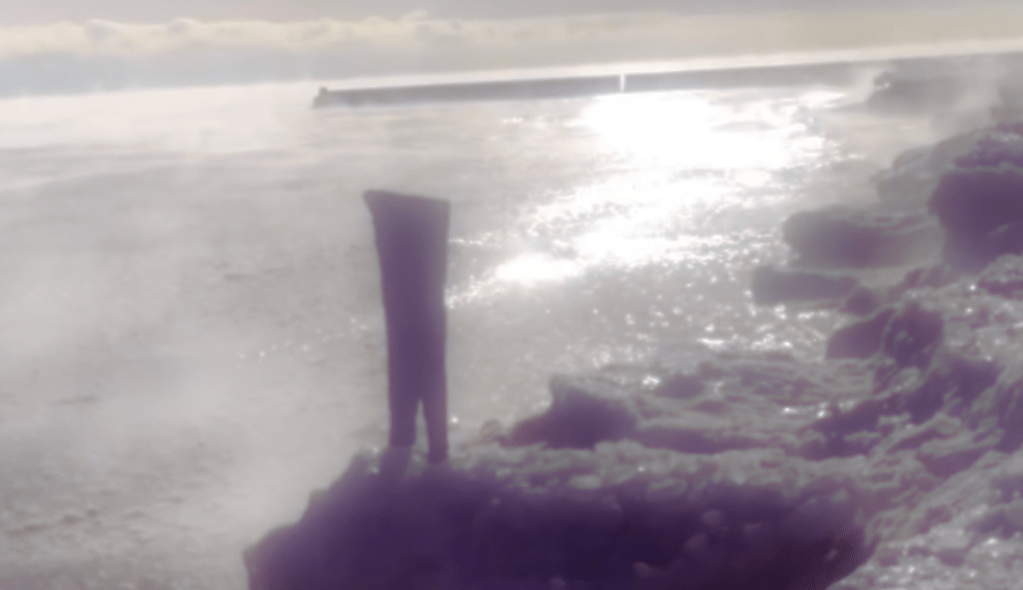
    The winter water forms a dulcet froth as it churns bubbles and ice and air.

    The winter sun is setting. Or rising. Skims of golden hour sunlight make their way through the water as the waves crest, whose murky character returns as they are pulled back into the depths. The lapping waves are dense with chunks of ice, tossing them about like buoyant pebbles, smoothing them to seaglass. 

    Larger waves toss the tumulted sea ice onto the frozen banks, where you can stand to watch the waves with relative safety; the largest piece could squarely cover the palm of your hand. Brushing against their melting point, the airy-icy cobblestones, covering every surface, glisten diffusely. The stones glide easily among and across each other, scattering at the slightest disturbance. Frictionless, cold, and slowly forgetting the churn of Lake Michigan they just endured as they bake out in the frigid air.

    The frozen bank is craggy, jutting in and out, ceaselessly bracing against the churn of the water, losing and gaining parts of itself with every wind-swept watery advance. As waves crash, clouds of glittering mist are drawn up from the depths, catching every ray from the drooping sun. The air hangs cold and heavy, bearing down indifferently on the activity of the water, a highly-contested battle between stillness and noise.

    In front of you, cresting a small mound of icy bank: standing tall, a frozen, defiant pair of skinny-fit denim blue jeans. 

  • Liturgy of the Sink Demon

    Liturgy of the Sink Demon

    My childhood home has been haunted since before I can remember. Not the kind of haunted that causes strange noises in the attic, and only sometimes the kind of haunted where the lights flicker conspicuously during arguments. 

    No, the entities that live here are agents of imbalance, self-sustaining in their madness; like a pot you can’t take off the stove that’s always threatening to boil over. An imp that has grabbed hold of something precious and has taken off running in a direction you didn’t quite catch. Seeds of chaos in the pipes entombed by a family’s survival through nearly three decades of both miracles and miasma. Clinging disorder that shrouds itself in layers of psychic fog, an embodied torpor that uses the brain’s natural circuitry against itself. 

    The very best example of this is the demon that lives in the kitchen sink. 

    From my childhood and adolescence, I recall memories of dishes piled high, sometimes days-old, threatening to collapse under the weight of white ceramic bowls, peanut butter knives, and lids that don’t quite fit anything. Bloated grains of rice and remnants of salsa jars and paper labels from cans would combine into a heterogenous slime near the drain, threatening psychic damage to anybody who dared disturb it. Newly washed dishes often mingled with dry ones on the rack. Chaos would grow from that plumbing, again and again, no matter how many times my mother fought it back down to the shiny stainless steel surface. 

    The demon did a great job sustaining itself on a household already destined to suffer from chronic stress—stress made extra spicy with a good helping of neurodivergence and disability. It fed off of the shame and indignance felt by the kids after continual naggings from Mama Bear, and the frustration of Mama Bear that her cubs only ever seemed to nurse more chaos than they could dispel, not yet mature enough to recognize her efforts. I know all too well as an adult that helpless situations beget depression, and depression saps energy; energy that could be put towards real, sustainable progress against the forces of evil.

    When we did buy a dishwasher, the demon made sure it was one that siphoned water from the sink’s faucet for the entire three hour cycle, leaving no room for washing or rinsing in the meantime. Attempts to help always somehow further entrenched the problem. What are you supposed to do with horrors that feed in the space between your physical surroundings and your subconscious?


    I’m grown now. Fledged. I left the nest no less than five years ago; I’ve made multiple households and communed (consciously and unconsciously) with many demons of my own in the meantime. I’m housesitting for my parents right now, and while the sink is quieter than it used to be, and many stresses have been lifted from this dysfunctionally functional family, I can tell this spirit is still working on me and my loved ones. What is it, truly, that the dregs of this sink demon wants from us, even after all these years? 

    As already wisely noted by the outstanding poltergeist whisperers of our time, the answer to any demon problem is acknowledgement; simple acknowledgement. Yes, there is a demon in my sink. Yes, it is doing everything in its power to keep us all merely surviving under a mountain of undone-ness. Yes, it demands tribute, daily, in the form of small tokens of recognition. To manage, I’ll honour it every so often with a simple verbal nod, paired with a small but meaningful decision, such as putting my plate in the dishwasher rather than the sink’s basin, or emptying the drain catch when I don’t have to. Yes, if I ignore the demon’s creeping tendrils, it will become irate, offended that I have no respect for its wretched potential. 

    No, I cannot destroy the demon; yes, I know it will always be there. This being said, yes, a moment of true, conscious recognition of its demon nature—the bravery to look a real evil in the eye, followed by consistent (even if imperfect) observation and reverence—can soften the miry grip of any malignant spirit.